He Charges Nothing Extra for Customization
Which tells you everything about everyone who does.
I asked a furniture maker about his process. He accidentally explained your whole house.
You know what you like. You just don't buy it.
You buy the version that's available, in the finish they offer, in the size that mostly works, and you tell yourself you're being reasonable. Because the moment you ask for the thing you actually pictured, the price changes.
I've been in this industry ten years and I want to name what that does to a person.
You learn that specificity is a luxury. That wanting your own version costs extra. So you take the standard one, live with it, don't love it, and quietly conclude the problem is your taste.
Then I talked to Christopher Dean.
He builds furniture in Eugene, Oregon under the name Handhold Studio. He resaws his own veneers. Almost every piece he has ever built has been customized. He charges nothing extra for it, and the design fee comes off the final cost rather than getting added to it.
The most exacting maker I've talked to this year treats your specific want as the baseline, not the upgrade.
Everyone charging you a premium for it made a pricing decision, not a craft one.

Image | the handholdstudio-The Cascade
Christopher: I formed my little handcrafted woodworking biz in Richmond, Virginia in 2015, but went full time in 2016. There wasn’t a major idea or a crazy awesome story like some people have. I’m a serial hobbyist, and I absolutely hated the work I was doing before this. I decided to pursue my self-employment + creativity and just dumped everything I had into it.
Woodworking just stuck as the thing that I could do for a paycheck! At the time, it just didn’t seem feasible to build my next closest dream at the moment, which was a Mercantile I’d name “Foraged + Fermented”, and it’d be filled with food, ingredients, and alcohol all foraged for and processed in-house. It’s still not fully off-the-table, hah!
In 2016 or so, most of the woodworking I was doing was rudimentary, with no joinery or complex design. Just the type of work that required me to do farmers markets, craft fairs, etc. It was fun while it lasted, but didn’t feel sustainable for my personality type. Just before moving away from Richmond, one of the last major events I got to be a consumer at was the Craft + Design show in Main Street Station. I saw a local furniture maker’s work that just absolutely blew me away — in his booth I felt I’d walked into my dream, that someone else was already living. That maker was Daniel Rickey, of Daniel Rickey Furniture.
In 2019, I packed up my shop and followed a job opportunity my wife had landed, which moved us to Eugene, Oregon. Once I was on this coast, things shifted for me as I became more interested in furniture + design. After DRF, makers like The Roaring Woodwork, Beauty & Bread Woodshop,TomFoolery Wood Co, Hambuilt, and proximity to material suppliers like Goby Walnut & GL Veneer — my mind just began going wild on the creativity and possibilities in finely handcrafted furniture.
It’s been a long journey to executing the place I’ve taken this thing to, now. It’s been slow at times and fast at others. It’s had its bumps & potholes, but it started as a dream and I’ve built it with my own two hands (+ the support of many people coming in to be my proverbial “village”).
I’m just a guy out here, still a serial hobbyist, and playing with ideas and creation within my realm now.
No Lightning Bolt
Nothing about that origin is tidy. No grandfather's workshop. No childhood revelation. A person who hated his job, liked making things, and spent years at farmers markets building work that didn't yet have tapered feet.
Notice what that means for you. He didn't arrive knowing. He arrived willing.
The specificity he has now was built inside the years it took to get here, which is the part nobody shows you when they show you the finished cabinet.

Image | thehandholdstudio-The Palisade Cabinet
Christopher: The first thing that most would notice about my furniture is that they almost all bear names of National Parks or prominent natural structures within them; the Shenandoah Liquor + Wine Cabinet, the Rainier Cabinet, and so on. Most of my work is inspired by the things that I see while I’m out in nature (I’m an avid National Park-er), mixed with a lot of the design styles that I see within the creatives who I respect.
The Shenandoah, as an example; is strongly inspired by softer rolling mountains, the top of the cabinet features a soft curved profile that makes me think of the Blue Ridge Mountains that I grew up around. The tapered feet on that cabinet are a design decision I made after a hike in Shenandoah National Park — there was a rock scramble and I had thought “Huh, nature just put this big rock on top of these little skinny, tapering boulders and that works??” It stuck.
There are a lot of nuanced details and personal life experiences like that built into my works. A big difference in my furniture compared to some others I see is how I encourage (and don’t charge extra) for customization. Almost every piece I have ever built has been customized because of it, too.
I know that my pricing can cause accessibility issues just due to its handcrafted nature and needing to pay us a living wage for a premium product, but it doesn’t change the fact that I don’t come from money and I want my work to be as accessible as I can make it. I’m not upcharging for changes to designs, and after paying my (small) design fee, I take it off the final cost of the custom piece, not in addition.
I like to work with new homeowners, and people from all walks of life who are investing in their first handcrafted item made exclusively for them. A lot of what makes my furniture different is in the experience — from design to consultation, to my willingness to hand deliver nearly anywhere in the country (if my queue is slim, I’ll drive it clear across the country, truly).
I’m here for the connection between people and things, and I don’t think there’s a lot of traction just yet in that thinking. There’s the “anti-fast furniture” ideological movement, but I’m trying to go deeper and connect you to something that you can cherish.
The Rock On The Trail
He was on a rock scramble in Shenandoah National Park and saw a large rock balanced on smaller tapering boulders. His brain said: huh, what if that was the base of a cabinet.
That became the feet on the Shenandoah Liquor Cabinet, which someone is currently living with, running their hand along, with no idea where it came from.
Here's what I want you to take from that.
He noticed something, couldn't fully justify it, and used it anyway. He didn't check whether tapered feet were trending. He didn't compare it to forty other cabinets first. Something caught his attention and he trusted that the attention meant something.
That is the exact move you've been talking yourself out of for two years.

Image | the Handhold Studio - The Shasta
Christopher: This is a very fluid answer, and it’ll change based on each client; some are so ready to go, some are anxious/nervous about the process and pricing, and some truly do not know what they want. It all starts with a consultation, though. Booking my consultation (which is go-at-your-own pace), I’ll bust out the ‘ol stopwatch, and we’ll dedicate two whole hours over the course of a day, days, and weeks, to talk design + sketch + I’ll get material options and pricing together.
I have a great habit of really handholding my clients through their creative thoughts, even if they’re struggling to articulate them. For design, I lean heavily into the pieces that my client is most attracted to. Even if you don’t know if it’ll fit the aesthetic of your space or the particular use, I want to know if you’re attracted to beading, tapered details, brass, and so on. It gives me an idea of what’s going to feel warm and invite you to interact with it.
From there, I’ll sketch out a couple of options, and we’ll see what you like from them (I’m no artist, they’re fairly rudimentary, but I’m always trying to practice to have that architect/engineer level of pencil sketching, ha!).
After we feel we’re on the right track to your design, there are revisions to details until it’s just perfect. I’ve got a personality type that screams “buy once, cry once”, and I treat my business the same. I recognize that my client’s money and time are incredibly valuable and in some cases limited, and I really will dedicate myself to making a design absolutely perfect for their needs before we get started on the build.
After design, it’s pretty seamless. Purchase or finance a custom listing, or we’ll agree on payment terms of some sort (I can work within a lot of circumstances), and then I begin. I’m making everything by hand, one at a time, so it is slower than a multi-employee company, but I also benefit from having the same eyes and hands on each project. Once completed, I’ll either hand deliver or have it freighted with a white glove service to your home.
Two Hours Before Any Cutting
Read that again with your own decisions in mind.
The person who actually builds the object spends two hours, sometimes stretched across weeks, talking and sketching and revising before a single cut. He describes handholding clients through creative thoughts they can't articulate yet.
So the next time you feel slow for deliberating over a credenza, remember that the makers deliberate longer than the buyers do. Nobody in the craft thinks fast decisions are better decisions. That idea came from retail, which needs you to move.
He also says he leans on what you're attracted to even when you can't explain why it fits. Beading. Tapered details. Brass. Not what suits the room. What pulls you.
I ask a version of that same question in every session I run, and I've never once had someone fail to answer it.

Image | thehandholdstudio - The Revisionist Teton Credenza
Christopher: I really recently prefer working with thick veneers, I resaw my own here in-house and have a full veneering setup to make insanely high-quality panels for projects. Otherwise, I enjoy walnut, as most do, and I love the warmth and tactile experience of incorporating brass or nickel into my work. I’m influenced by a lot of makers whose creativity and execution are top-notch; Daniel Rickey, Phil Morley, MediumSmall, J.Rusten Studio, Brockway Ayres. I’m also really inspired by the people whose designs and/or mediums are different than my own, but they’re very supportive and encouraging of my work. It reinforces that I’m doing something cool, and it pushes me forward in just tinkering around sometimes. People like Robby Simon (@play.room), as an example.
He Names Standards, Not Styles
Look at who he lists. Not aesthetics he wants to copy. Makers whose execution raises his own.
That's a different kind of influence than the one you've been practicing. Saving four hundred images of rooms you want to resemble is copying. Keeping company with work that raises your standard is something else, and it doesn't require you to reproduce anything.
One good piece does this to a room. It raises the standard of the conversation, and every provisional choice around it suddenly becomes visible for what it is. That's not intimidating. It's the cheapest diagnostic you'll ever run.
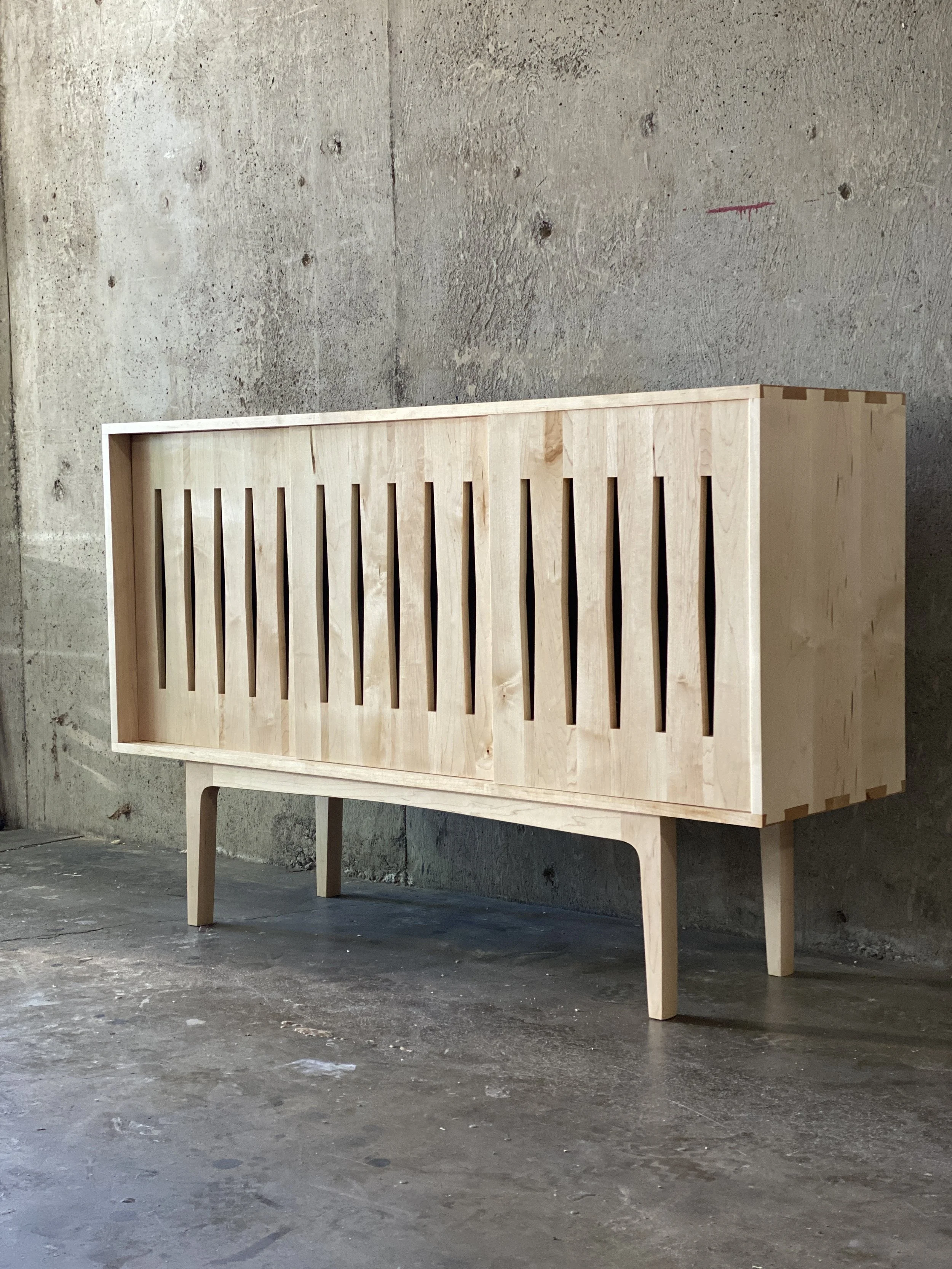
Image | the Handhold Studio - The Teton
Christopher: Environmental consciousness is pretty visible in my periphery, I’m always on the lookout for more sustainable wood sources, or cutting my hardwood veneers and putting in the extra labor to attach them to a more eco-friendly and superior-made substrate. My shop doesn’t do epoxy pours, at all, and I’m using natural + plant-based finishes. I try and ship my pieces in batches/deliver in batches, to reduce the carbon footprint of long trips for one thing. A lot of eco-conscious practices also are budget-friendly practices. Less trips = less fuel costs, and so on. I’m a little shop, so doing my part and also helping my budget are important.
Somebody's Name Is On It
No epoxy pours. Plant-based finishes. Veneers cut in-house. Deliveries batched.
These aren't positions taken for a market that decided to care. They're the consequences of a person deciding what he'll put his name on.
That accountability doesn't exist in fast furniture. There's no maker who'll drive it across the country and stand in your living room wanting it to be right. There's a price, a delivery window, and the low hum three years later that you should have waited.

Image | the handholdstudio - The Santa Elena Fridge + Dry Bar Cabinet
Christopher: It’s everything. I’m the Handhold Studio, after all. I want this to be a lifelong and permanent connection between you, your work, and myself. A never-ending collaboration, in a sense. I do offer customization options; material options, finish options (for color/stains sometimes I bring in outside, more expert help), pricing structures, dimensional changes, and so on. The possibilities for customization are truly endless.
Endless Is The Word
Not a range of options. Not a good, better, best. Endless.
Material, finish, dimension, even how you pay. Nowhere in that answer is there a version of you he isn't willing to build for.
Now think about the last time you shopped for anything. Three finishes. Two sizes. A configurator that grays out the combination you actually wanted. And you adjusted, because that's what there was, and you called it a compromise and moved on.
You've been trained to shop inside a menu somebody else wrote, and then to interpret the limits of that menu as the limits of what's reasonable to want.
He's not being generous here. He's a one-man shop making things by hand, one at a time, which means every piece is custom by default. There's no assembly line for a variation to interrupt. The limits you've been shopping inside are a manufacturing convenience that got sold to you as a taste lesson.
Christopher: I’ve worked with a handful of small businesses + brands in the past, most recently Parlour & Palm, an interior design service in Portland, Oregon. I was brought in on a custom Santa Elena Wine Cabinet for a rad client. 10/10 would recommend. This April I launched a rebrand for my company, and the mission this year + moving forward is community + creativity, looking for small businesses and people in my local community + broader, to find ways to work together, publish together, and succeed together. I’d love to develop more of a local community here in Eugene the way I’ve been able to elsewhere, but I’m in this for the connection + and travel and would love to make friends and collaborative partners everywhere.
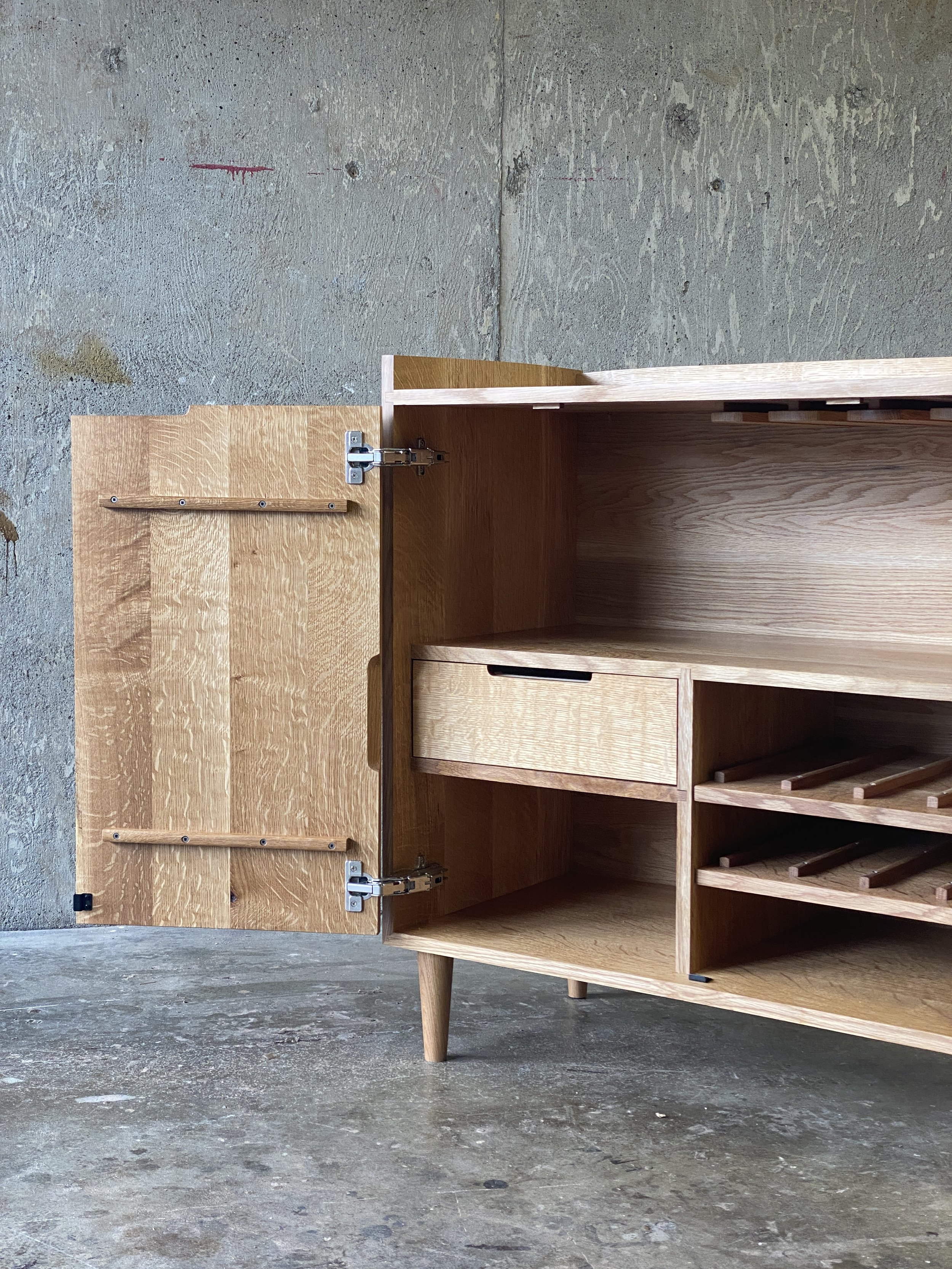
Image | the handholdstudio-Shenandoah Liquor Cabinet
Christopher: This is something I’m still figuring out for myself, or where I fit in, honestly. I come from very deep Appalachian family roots — I grew up with stories of my dad + family in coal mines and life in “hollers”, over biscuits and fried apples. In my late teenage years, when I left home and started exploring the country as deeply as I could, I found that I was always looking to bring that little piece of quiet, slower life with me to cities, other cultural areas of the country, and so on. Now, in my 30s, I think I’m just getting to a point of realizing that I can take those slow-down ways of life with me into my faster-paced world, and build a community around my own little metaphorical “front porch”. In my designs, I have long called some of my work “Mountain-Modern”, like, for years now. Some of my works have been directly inspired by old pieces I’d seen in old mountain homes, where practicality and pragmatism mattered more to people than embellishment or frivolity.
The Front Porch
I didn't grow up near coal mines or mountain hollers. I understand the thing he's describing anyway.
Your home is the front porch. It's where you get to set the tempo regardless of what the rest of the day did to you.
He calls his version Mountain-Modern. Mine is the M.I.N.D. Method. Same refusal, different vocabulary: the speed of everything else does not get to decide how you live inside your own four walls.

Image | the handholdstudio-Shenandoah Liquor Cabinet (Quarter Sawn White Oak)
Christopher: My future aspirations would be just to thrive within the means that I aim for. I want to make a stable living wage doing what I love, nothing else matters. I've no lofty goals of hitting the 7 figure years like influencers push, and I've got no goals to compete or surpass others. I want to work with people, be happy at the end of my day, and feel proud of the work that I do.
I've got a few exciting designs in the queue this year, particularly a new line of plywood-centric furniture (so you can paint it yourself), as well as completely new designs to be added to my permanent rotation of works. I see my brand evolving to fit into this mentality more with time. The rebrand I just went through helped to immediately shift the message and my goals, and I see things growing toward that. More collaboration, more quality, more client-collaborative pieces, deeper relationships.
Nothing Else Matters
A stable living wage doing what he loves. Nothing else matters.
We're not supposed to say that out loud. We're supposed to want the seven figures and frame ambition as expansion.
The reason this belongs in an article about your living room: the person who works this way makes things differently than the person chasing a number. And you can tell. Not mystically. In the finish that goes all the way to the back of the piece where no photograph would ever look.
Christopher: For woodworkers, look to people whose work you love, and identify the parts that you love. *No one* is making new/original things with wood, at this point, we’re all just combining and evolving the things that we love to make something authentic to our styles. Don’t be afraid to ask questions, find help, etc. I’m always here to help problem solve or support design or execution for up-and-comers. Motivation can be hard. For some businesses, it seems very easy. My work has been lonely, and tiring at times. For me, always looking for my community has helped me keep my head in the right place. Tracy (@hellodaisymade) is a great example of someone I rely on for a little kick when I’m just in a rut — when I’m just really in a funk, I think all business owners and creatives need a network of people, (or in atleast one person) that can read that downward mental/motivation trajectory and help realign them to their goals. Find yourself that person, and make sure you tell them you appreciate them. Some days people like that are the only coals keeping your fire going.
Nobody Is Original
This is the sentence I'd tattoo on the inside of your Pinterest boards.
A man who cuts his own veneers, whose joinery is extraordinary, who has spent a decade refining a single body of work, says nobody is making original things with wood anymore. Everyone is combining and evolving what they love.
So the standard you've been holding yourself to, the one where your taste has to be original before you're allowed to commit to it, is a standard that does not exist at the top of the craft.
Your saved images aren't evidence that you're derivative. They're the raw material. That's how it works for everyone, including the people whose work you're saving.
And on his last line, about finding the person who can read your downward trajectory and telling them you appreciate them: I'm not adding anything. Some sentences arrive finished.
The Particularity Tax
Christopher and I work on opposite ends of the same problem. He builds the piece worth keeping. I get people clear enough to choose it.
But the thing I'll actually carry out of this conversation is his pricing.
He treats your specific want as the starting point. Not an upcharge. Not a premium tier. The default.
Every time you've been charged extra to have what you actually wanted, you were being taught a lesson that isn't true: that being particular is an expensive habit you should probably grow out of.
You're not too picky. You've been shopping in a market that prices particularity as a luxury, and then you took that personally.
Find Christopher's work at @thehandholdstudio. Mention ARDISENOSTUDIO and use the code ARDISENO10 for a courtesy discount.
And if you want to get clear before you commission anything, that's where Design Mood begins.